GAS TURBINES
MAIN THEMES
● Introduction
● Main types of gas turbines
● Basic parameters of gas turbines
● Stage of gas turbine
● Stator of gas turbine
● Rotor of gas turbine
● Multistage gas turbine
● Stator cooling
● Conclusions
INTRODUCTION
● In turbines is converted heat and pressure energy to kinetic energy and mechanical work with very high efficiency
● The conversion is provided in stator and rotor canals
● In stator vanes is converted heat and pressure energy to kinetic energy
● In rotor blades is converted heat and pressure energy to kinetic energy and mechanical work
● Obtained performance on turbines is exploited for compressor and assembly drive. In case of turboshaft engines, performance is also used for propeller or rotor drive.
● Ground power unit use converted energy for drive of electric generators or compressors and many types of equipments.
REQUIREMENTS
● High performance
● High reliability
● High lifetime
● High efficiency
● Minimal weight and dimensions
● Simple construction and maintenance
● Low price
GAS TURBINE TYPES
TYPES BY DIRECTION OF FLOW
● Radial
● Centrifugal
● Centripetal
● Axial
TYPES BY INLET FLOW FIELD
● Turbines with homogeneous inlet flow field
● Turbines with non-homogeneous inlet flow field
TYPES BY NUMER OF STAGES
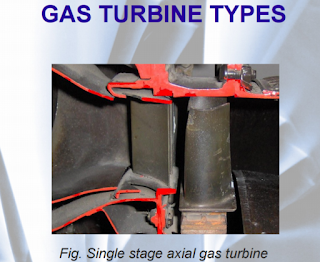
● Single stage
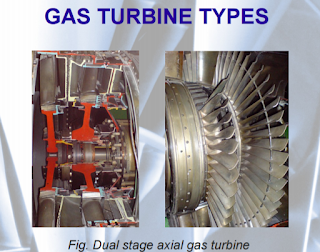
● Dual stage
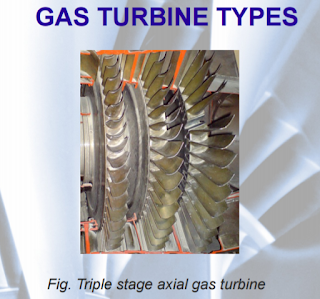
● Triple stage
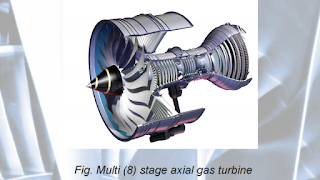
● Multi stage
TYPES BY NUMBER OF SPOOLS
● Single spool turbines
● Dual spool turbines
● Triple spool turbines

TYPES BY REACTION OF STAGE
● Impulse stage
● Impulse/Reaction (Reaction) stage
Flow rate
● Depends on construciton 0,5-300kg.s-1
Thermal gradient
● Max. 30kJ.kg-1on one stage
Temperature before turbine
● Non-cooled turbines max. 1000°C
● Cooled turbines 1200°C and more.
RPM (Revolutions per minute)
● Depends on construction 5-90.103 min-1
Reliability
● Means reliability of blades. At present days in modern engines its approximately 10000 hours.
Efficiency
● Single stage turbines 0,82-0,90
● Multi stage turbines 0,88-0,94
Cooling air
● Depend on intensity of cooling (approximately 5% from flow
rate)
TURBINE STAGE
Forces on rotor blade are created by:
● Aerodynamic forces created by fluid around
blades (impulse action of gases)
● Reaction action of gases in convergent rotor
blades canal where are gases accelerated
● Work transferred to blades of elementary stage from 1kg of gas From Euler equation:
● Efficiency of multistage turbines is higher than efficiency of every single stage (in compressor that's NOT true)
● Efficiency of multistage turbines is 0.88-094
● Efficiency increasing by number of turbine
stages.
● Efficiency of multistage turbines is higher than efficiency of every single stage (in compressor that's NOT true)
● Efficiency of multistage turbines is 0.88-094
● Efficiency increasing by number of turbine stages
● Lower velocity of gases as in single stage
● Losses from stage before are exploited in the next one
Reaction of elementary stage
● Is ratio of adiabatic static work of rotor and
adiabatic static work of elementary stage.
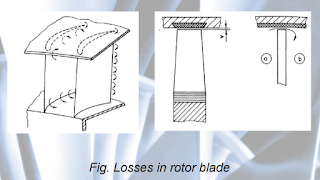
Profile losses
● in stator and rotor as well
● These losses are generated as soon as gas
fluid around vanes/blades.
● Friction losses (boundary layer)
● Shock phenomenas
● Wakes (high angle of atack)
● Profile losses are higher in rotor.
Secondary losses
● Generated by pair-wakes (induced drag)
● Losses in redial spaces between rotor blade
and turbine caseOther losses.
● Losses in bearings
BLADE GEOMETRY
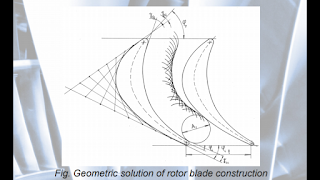
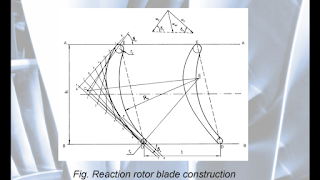
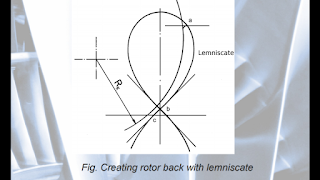
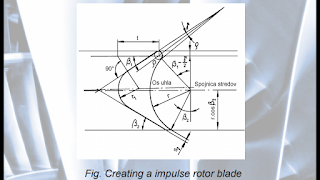
● Characteristic shape of rotor blade is the longitudinal shape
● In elementary stage is determined in the middle diameter ( by flow equation )
● The real flow is spatial. The peripheral speed is increase from rotor root to rotor tip. Absolute velocity and pressure changed as well. All of these parameters are connected
● The real flow is – spatial, compressible, viscous and non-stationary
● GEOMETRY of blade must accepted these facts.
MULTISTAGE GAS TURBINE
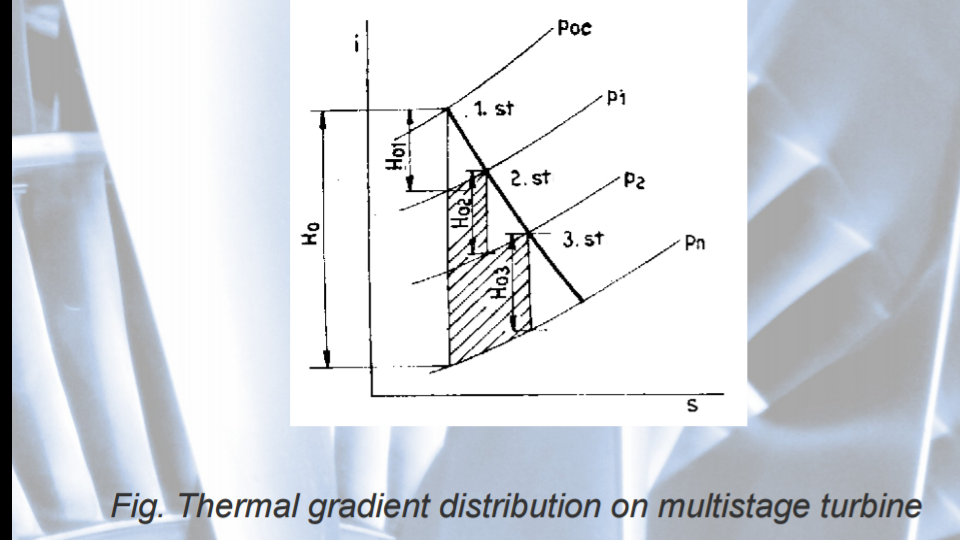
● Created by compiling of turbine stages in a row
● Modern engines used 6 and more stage
turbines because:
● There are high thermal gradients
● Higher efficiency
● Better collaboration with compressor ( bigger diameter – lower RPM )
● Smooth shape of engine
GAS TURBINE COOLING
Sources of cooling
● Air from fan
● Air from low pressure compressor
● Air from secondary flow on CC
● Air from secondary flow ( turbofan engines )
BLADES COOLING
Methods of blade cooling
● Convective ( Internal cooling )
● Film cooling
● Transpiration cooling
Film cooling
● Cooling is provided with cooling air, which is delivered through the holes on the blade surface.
● Cooling with air film is more efficient as convective cooling.
● Transpiration cooling
● Transpiration cooling is similar technique of
cooling as cooling with air film.
● In this case is generated a homogeneous
surface of cooling air on surface of blade
● Transpirationally cooled blades have no holes.
Air flow through the porous surface of blade.




 المشاركات


